 DroneScout
 Bridge ds110
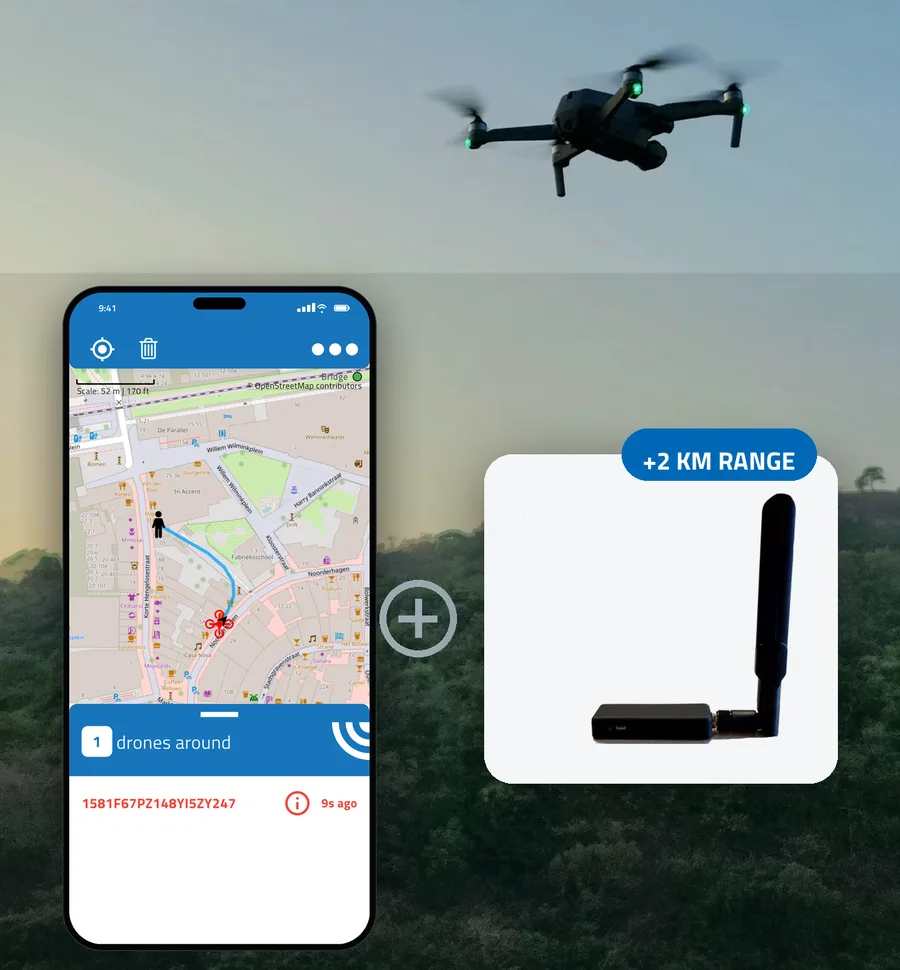
Your phone misses most Remote ID drones. The ds110 receives them on every Remote ID transport, on 2.4 and 5 GHz, and passes them on to any iPhone or Android phone — up to 2 km away.
€149 excl. VAT · worldwide shipping · quantity discounts from 3 units
Why your phone needs it
Drones broadcast Remote ID over several radio transports, and phones receive only some of them:
- An iPhone can't receive Bluetooth Long Range S8, and iOS doesn't let apps scan for Wi-Fi Beacons — which is what most drones, including DJI, use. Without Bridge, an iPhone sees only Bluetooth Legacy broadcasts. See the FAQ.
- Many Android phones lack Bluetooth Long Range S8 or receive it badly, and Android throttles Wi-Fi scanning to about twice a minute. See the FAQ.
- Some drones, such as Skydio, broadcast only on 5 GHz. Most Android phones can scan 5 GHz Wi-Fi, under the same scan limit; an iPhone can't receive it at all.
- Some transmitters send invalid Wi-Fi frames that don't follow the Wi-Fi standard. Android discards them before any app sees them; the ds110 reads the raw radio frames itself, so it receives them anyway.
How it works
The ds110 listens on Bluetooth Legacy, Bluetooth Long Range S8, Wi-Fi Beacon and Wi-Fi NaN on 2.4 GHz, and on Wi-Fi at 5 and 5.8 GHz. Everything it receives, it rebroadcasts as plain Bluetooth Legacy, which every phone and tablet receives reliably.
Besides the US and European Remote ID standards, the ds110 also receives China's GB 46750-2025 (Bluetooth and Wi-Fi) and France's national signalement électronique (Wi-Fi), and relays them to your phone the same way — so these drones appear in DroneScout on an iPhone too. These two are relayed to the phone only, not output over MAVLink. This needs firmware 20261027-1727 or newer, see Use DroneScout Bridge. The French signal is converted to standard Remote ID, so any Remote ID app shows it. Chinese signals are either converted the same way or relayed as GB 46750-2025 over Bluetooth Legacy, which DroneScout also decodes.
- No pairing. The relay uses ordinary, connectionless Bluetooth: switch the ds110 on and the drones appear in the app.
- Works with any Remote ID app that receives Bluetooth — the free DroneScout pro app or your favourite one.
- Powered by USB-C, from your phone or a USB power bank, or through its JST-SH connector.
- Range up to 2 km with the included 5 dBi antenna, which you can swap for another antenna. The actual range depends on the drone, the terrain and interference.
Also for drones and integrators
- Detect and avoid: the ds110 can output every detected drone as MAVLink messages (ADSB_VEHICLE or OPENDRONEID message packs) on its UART connector, for DAA on your own drone or aircraft. Example Python and C code is available.
- Compliance checks: it runs 10 basic checks on a drone's Remote ID broadcast — handy to test your own drone.
- Reception details: in OPENDRONEID mode, the ds110 also outputs an OPEN_DRONE_ID_RADIO_RX_INFORMATION MAVLink message with the signal strength (RSSI), transport, channel and time of each reception.
- Firmware over UART: upgrade the firmware, reboot or read the device info over the UART connector, with the firmware_upgrade.py script.
Specifications
| ds110 | |
|---|---|
| Receives | Bluetooth 2.4 GHz, Wi-Fi 2.4 GHz, Wi-Fi 5 and 5.8 GHz |
| Standards | ASTM F3411, ASD-STAN EN 4709-002, GB 46750-2025, French signalement électronique |
| Relays as | Bluetooth 4 (Legacy) |
| Antenna | 5 dBi, RP-SMA connector, replaceable |
| Detection range | Up to 2 km |
| Power | USB-C, or JST-SH 4-pin |
| Average power use | 450 mW |
| Connectivity | USB-C (serial), 2× JST-SH 4-pin (IN and OUT) |
| Operating temperature | −40 °C to +85 °C |
| Size | 71 × 24 × 13 mm without antenna; antenna 157 mm |
| Weight | 32 g |
Full details are in the manual (PDF).
Other models
The ds111 is smaller and cheaper, with an internal antenna and up to 1 km range. The ds100 receives 2.4 GHz only. PCB versions without enclosure are available for integration into your own products. Compare all models at dronescout.co/bridge.